For more than five years, Prof. Neri Oxman, formerly a faculty member at MIT Media Lab, who has received awards as one of the most influential researchers in design, architecture and technology, has been working outside the university, and with little media attention. During this time, she founded OXMAN, a company intended to implement her scientific ideas in the real world, but so far little is known about its products, employees, and customers.
Anyone who goes into the company’s website is likely to leave it confused, but inspired. At first it looks completely dark, and only after interaction with it do the questions start to appear: "Can buildings rewild ecosystems?", "Can molecules encode communication signals of polycultures?", and one answer: "We envision a world where Nature and humans cocreate as one."
So what’s actually happening there, at the offices of the Israeli researcher who has become a global celebrity and who in recent years has divulged only crumbs of information about her activity? We bring you, for the first time in the Israeli media (and almost anywhere), the story of the company she set up, and try to understand how her ambitious ideas could look and make an impact in reality.
" I’ve been in academia for almost 25 years, first as a student and a PhD scholar and later as a tenured member of the faculty at MIT," Oxman relates in an interview by correspondence. "My next 25 are dedicated to putting inventions out there in the real world, to pushing against the grain and to making real impact.
"When I moved to Cambridge, my NYC friends used to say that Boston is ‘a practice city.’ I find that academia is very much like that, a sliver of the world that’s protected from it. A place where you’re allowed and even incentivized to dream big without fully turning your inventions into real-world change at massive scale. It’s a double edge sword."
The conversation with Oxman takes place at a rarified level. There are those who assert that she uses long words to hide from genuine scrutiny of her work; others see her verbal style as part of her art. But in correspondence with her, Oxman sometimes suddenly becomes down to earth, and even translates the vision into real products and projects that the company is working on. The conversation with her thus takes place simultaneously on several levels.
You seem to have a special relationship with nature. While most people seem to me to be predominately either nature-appreciators or nature-changers, you see it in a different way, that you can appreciate nature and use it to change itself.
"For good or bad I occupy the space between appreciation and change, between reverence and transformation. ‘To be and not to have’ are words we often utter at the lab. To revere nature without losing the craving to interact with it, to respect it without losing the ability to interact with it.
"In so many ways we have collectively lost touch with our connection to nature. We respect nature from afar, often just as an idea. We count carbon, put our groceries in canvas bags, but we never put our hands in the garden, our feet in the mud. What I’m interested in is closeness, relationship.
"I love how you phrase it, ‘to use it to change itself’. Empowering nature, without the emphasis on human-centric pretense, is really what we are after. How can we empower nature to help itself while also helping humanity. Can there be synergy between natural production and human consumption? What’s the golden ratio?
"One of my daughter’s favorite books is ‘The Giving Tree’ by Shel Silverstein. I cry every time I read it because it depicts so completely our broken-yet-hopeful bond with nature. And right now, we find ourselves reliving the last scene in the book, where the boy is now an old man returning to the Giving Tree for one last time. He no longer has the need for things material-money, a house, a boat. He’s after ‘a quiet place to sit and rest.’ The tree has nothing more to offer, but a small place to sit. And despite all the taking on the boy’s part, and all the giving on the tree’s part, the tree still loves the boy. Unconditional love.
"We are altogether after a different plot. Not The Giving Tree but The Growing Shoe, a Rewilded City, a Restored Ecosystem. In this story, humans are the givers and we, humans, and nature reunite as unadulterated partners. A love story."
The shoes that Oxman mentions are already advertised by the company. In accordance with her vision, the shoe combines programmed living organisms (in this case bacteria) to grow the material, which is then shaped by means of robots. The materials of which the shoe is made are called PHAs - polyhydroxyalkanoates - a perishable polymer. With this method of production there is no need to transport a range of materials to a shoe factory. The shoes themselves are covered in various fabrics according to their required function, and the fabric is also perishable.
The O° shoes look amazing! When do you think we’ll be able to buy them?
"O° was born as a biodegradable single-material shoe that brings you closer to the earth and in turn, closer to yourself. It’s a physical expression of the ‘get closer’ mindset, an antidote to the problem of disconnection.
"Production at scale is a challenge we welcome, especially since the creation of PHA yarn, as far as we are aware, has never been accomplished before. With regards to thermal degradation, the intention behind the first concept shoes we created is to degrade naturally, in entirely ambient temperatures.
"It’s ironic, right? How with food, biodegradation is a sign of freshness. Not so with shoes. P-FAS is the currency of permanence, and we need to break this cycle. So yes, while PHAs and bio-TPU’s are not even close to their synthetic counterparts in terms of mechanical performance attributes, it’s a starting point. We need to start somewhere."
The company is also working on biological pigments, produced by engineered microorganisms. Oxman promises that within the year we’ll be able to see and touch these biological fabrics and that she’ll launch a new electronic product, a "breath" meter that measures the biological degradation of perishable products.
Customers in real estate
On a completely different scale, Oxman designs building complexes and parks. What is special about them is that they are full of nature, inside and out, and some of the construction, like the production of the shoe, is carried out with the help of living organisms. Special calculation methods are used to work out how to plant the living materials so that they will develop into the system that Oxman envisions.
You shape complete ecological systems?
"Exactly! Ecosystems around the world already sequester about 50% of our carbon emissions and filter all our drinkable water. Those ecosystem services amount to a $140 trillion economy that’s entirely undesigned. By tapping into this dynamic economy, we can design and engineer ecosystems that can do things humans cannot do: sequester more carbon, filter more water, increase biodiversity, rewild and restore endangered habitats, and so on."
Can you give a simple example?
"We often share the following example: If you have one hectare of land, a little bit bigger than a football pitch, you can sequester over 40 tons of carbon every single year if you design it thoughtfully, as an ecosystem. This alone can cool a home and cut down on its energy by 50% if done thoughtfully, as well as filter a sufficient supply of water for thirteen neighborhoods if you design it correctly.
"The big question then becomes, how to design ecosystems thoughtfully? How to design a world where people can design ecosystems that accomplish the kinds of tasks we and they need? How to design ecosystems that do things that we cannot do? This is where EDEN comes into the picture."
EDEN stands for Ecosystem Design and Engineering for with and by Nature, a project within the company that is gradually developing into a company in its own right.
"As part of our EDEN platform, we are building technologies for AI-driven ecosystem design and engineering," Oxman says. "Ecosystem engineering is the process by which organisms like beavers and coral reefs actively shape their environment, as well as the physical and biological attributes of an ecosystem. Rather than facilitating the thriving of certain species, our goal is to support the thriving of entire ecosystems.
"EDEN’s technologies enable our clients to maximize ecosystem services such as increased biodiversity, thermal buffering and air filtration while augmenting human-centric functions on sites that are dozens to hundreds of hectares in surface area. These technologies enable us to think of ecosystems in architectural terms and of landscape architecture in ecosystem terms."
Who are your clients, and how large are your sites?
"In 2025 alone we designed for almost 800 hectares of land, across several clients. We’ve worked on over 128 species of plants and animals around the world. Our first client was a global industrial real estate company, The Goodman Group. They own, develop, and manage logistics and warehouse properties across major cities worldwide, focusing on sustainable infrastructure. While we continue our work with The Goodman Group, we have signed on a new client focusing on a large former landfill site of roughly 375 acres, transforming a landfill into a mixed-use site. We are growing!"
As we were preparing this article, Oxman informed us of the signing of an agreement with real estate company Greystar.
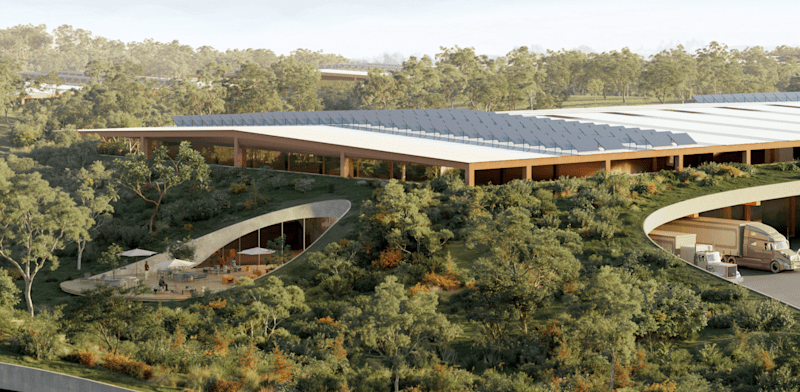
Impression of EDEN project in collaboration with real estate developer Goodman Group courtesy of OXMAN
What is the anticipated business model of OXMAN? Do you intend to take your products directly to the market at some point, maybe to make sure that your vision is preserved in the packaging, delivery, and marketing of the product as well? Or do you intend to license most of the products to focus on inventing?
"I set up OXMAN originally as a design R&D lab, an incubator. Five years later, we are at the point where we are getting ready to launch new entities into the world. And to each its own. EDEN is almost entirely self-sustaining. O° and textiles are still incubating. The Alef instruments team is beta testing our first instrument.
"With EDEN we employ a hybrid approach that integrates foundational research and development directly into our design processes. Our integrated workflow unites advanced computational methods, environmental simulations, and ecosystem optimization strategies to deliver solutions tailored to both site-specific conditions and client goals. Our interdisciplinary expertise spanning ecological modeling, environmental design, computational geometry, and landscape architecture enables us to generate innovative interventions that are adaptive and ecologically grounded. ?
"With O°, our goal is to lead the way of bio-design with day-to-day functional products. With Alef-we have created a suite of tools that increase our connection with nature, with our first coming out this year, Amen. ?
"Our work with our customers involves research. On the one hand we plan and create new products and environments, and on the other we develop the robotic technologies and the digital environments that produce them, and they remain our intellectual property, which we can offer through licensing.
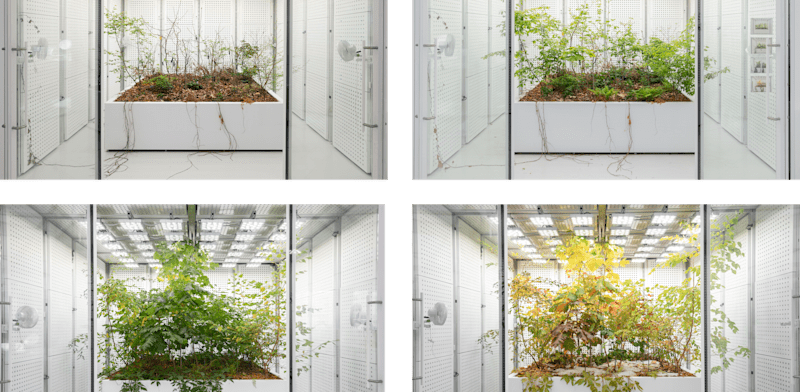
Ecological capsule at OXMAN courtesy of OXMAN
"The projects are intended to be a kind of north star that points to the way of the future, and the technology makes it possible to implement the work at the relevant scales, but I’m also learning that there’s value to design without scale, that there’s value to art, that there’s a place for poetry, and that it’s important to continue with the vision."
Uniting the team with Gaga
I read that you also do Gaga, the guided and free movement method devised by Israeli choreographer Ohad Naharin, which is now practiced in workshops around the world. How does Gaga fit into your life and work?
"I think we think alike, Ohad and I. We both think of our work, be it dance or design, as language. Like Ohad, I like to think that we approach our respective artforms-movement and making-from a radical rethinking of how we move our bodies from within/shape the world around us, why we move/why we build, and what movement awakens inside the body/what designs awaken the natural world.
"I like Gaga-ing as a way of bringing my team together, summoning the communal energy in our space. Since our work is so interdisciplinary, and we operate across various domains, it is important to keep the communal energy at the right vibration and celebrate the many ways in which everyone in the space can affect one another. Without mirrors, without judgement, without correction. Movement for the sake of movement. An expression of shared consciousness and connection, without a need to perform."
Scent of a distant past
Oxman also deals in reviving endangered ecological systems. "On the molecular scale, we are bringing back to life an almost extinct ecosystem. It is currently thriving upstairs in a data-driven grow room designed to enable the growth, evaluation, and maintenance of a now endangered ecosystem, one of the most biodiverse in New York State. We even created a smell from that capsule that embodies the various biogenic molecules of this almost extinct ecosystem. Plant competition in a bottle of the most biodiverse ecosystems on the Island. The smell of an ancient past." Once again, Oxman ranges across orders of size: a complete ecosystem, and a bottle of scent.
She sees these unique growth systems, which preserve the past, as vital for dealing with the climate crisis. "If microplastics are our nemesis on the product scale, and carbon emissions on the ecosystem scale, monocultures are the culprit of the food industry. We are all for polycultures and in our grow room you can find an ancient deciduous polyculture brought back to life using our high-resolution, data-driven grow room. We believe it is one of the most biodiverse ecosystems in New York, right here at our Lab.
"Not unlike our work on Eden, where we are employing AI to shape ecosystems, here we are utilizing AI to inform the location, density, and environmental conditions of every plant in this endangered ecosystem. It’s been thriving, and we’ve been enjoying the taste of 450-year-old blueberries … we are currently in the process of shielding this ecosystem back into the wilderness, hoping it will continue to survive and even thrive."
You have spoken in the past about an ambition to connect between organisms so they can communicate through a human-made (or at least human-designed) information system, and maybe connect between people and nature. How do you imagine a world where this is possible might look? Will that make nature more like us? And is that desirable?
"Sort of. The underlying working assumption at our lab is that if we can better understand nature’s ‘language,’ we can tap into unexplored opportunities. Imagine an interface designed such that plant smells and animal sounds are all processed and interpreted in real time. Think ‘The Wild Robot.’ That was the starting point for our design platform, ALEF.
"Will an iPhone for nature make nature be more like us? I don’t know. Maybe it can make us be more like nature. One way or another, a Wild Robot-type future is coming, and we want to be sure to capture the opportunity and the magic of whispering to bees and listening to birds. We want to offer ways to express what that romance can look like, sound like, feel like. And, yes, we have a first prototype embodying a slice of this philosophy that we are beyond excited to share with the world this year."
From Haifa to MIT
Oxman was born in Haifa in 1976. Both her parents were successful architects and researchers at academic institutions. Her father, Prof. Robert Oxman, who was born and educated in the US, is a leading figure in architectural studies in Israel. He is dean emeritus of the Faculty of Architecture and Town Planning at the Technion-Israel Institute of Technology, and professor emeritus of Architectural and Design History and Theory. He aspired to make architecture a research-based profession. Her late mother, Prof. Rivka Oxman, who died last year, was also a professor of architecture at the Technion. She was vice dean for teaching at the Technion’s Faculty of Architecture and Town Planning, and was also a visiting professor at Stanford University and at other institutions. Robert and Rivka Oxman had two daughters, Neri, and Keren, an artist.
"Growing up in Haifa my childhood was close to nature. The waves, the air, poppies, pinecones. My mother would take my sister and me to Ya’arot ha’Carmel almost weekly, and the winding road leading out of the city through Daliyat al-Karmel and the woods was her favored route. She would pick it any day over Freud [Road]. She loved being in nature, she would come to life in the woods, in the sea, on the mountain." ?
Oxman studied at the Hebrew Reali School in Haifa, and after military service as an officer in the Israel Air Force she studied for two years in the Faculty of Medicine at the Hebrew University of Jerusalem, but then decided to switch to studying architecture at the Technion. From there she continued to the Architectural Association School of Architecture in London (AA).
"I don’t think my preoccupation with nature as part of our work was rooted in my childhood," she says. "When I worked on my thesis at the AA, which was focused on performance-based design, elements in the natural world were things I could model, evaluate, and analyze. That’s where my love of computational methods for ‘form-finding’ began. My first objects were pinecones. Childhood artifacts."
AT MIT, Oxman began her holistic research combining nature and architecture. "My PhD was based on my master’s thesis, and rather than focusing on performance-based architecture I shifted to performance-based tools for digital design, specifically additive manufacturing, also known as 3D printing. I was interested in robotic digital fabrication techniques such as 3D printing as basic methods for generating and ‘growing’ forms."
On completing her doctorate in 2010, Oxman was accepted to the MIT Media Lab, a department at MIT that specializes in holistic, interdisciplinary research. During that period she began to make her mark in the design and artistic worlds. She has featured at exhibitions, including two retrospectives, in 2020 at the Museum of Modern Art in New York and in 2022 at the San Francisco Museum of Modern Art, an unusual achievement at such a relatively young age. One of her best remembered works is The Silk Pavilion, a work woven by 6,500 silkworms. She also designed for the singer Bjork a mask based on the culturing and 3D printing of cells from the singer’s face.
Oxman also designed products for industry, among them a "skin" applied to buildings. Developments by her have also been incorporated into medical valves. During her time at MIT she registered fifteen patents that were approved in the US, and she now writes patents in the name of the company.
More recently she has become known to the general public, thanks to, among other things, a Ted Talk that won millions of views, the surprising connection with the actor Brad Pitt, and the documentary film made about her by Netflix, in the Abstract series. In 2018 she became engaged to the billionaire Bill Ackman and the couple married in 2019. Their daughter was born that same year.
In 2020, Oxman left MIT and opened her company, with the aim of taking her inventions into the real world. This was preceded by the revelation of a $125,000 donation that Oxman’s Mediated Matter lab received from Jeffrey Epstein, who was later charged with sex trafficking of minors, when some of his misdeeds were already known. This was one of several donations that MIT received from Epstein. Oxman explained in a letter of apology about the matter that she had been told by more senior people at MIT that Epstein wanted to atone for his sins, and that his name should not be revealed as a donor so that his reputation would not be enhanced by association with the university. "I regret having received funds from Epstein, and deeply apologize to my students for their inadvertent involvement in this mess," Oxman wrote at the time.
Enduring connection with Israel
It would seem that the attempt to involve her with Ackman’s campaign against anti-Israel movements on US campuses died down more quickly than the Epstein affair, perhaps because in recent years she has said little in public about matters not directly connected to her work.
To "Globes", she agrees to say, "The past years have been heartbreakingly painful and there are no words with which to describe, approach or remedy what we’ve been through. As a people, as a species, as a civilization. It is a multi-dimensional pain because it inhabits so many facets of our existence during our lifetime and the lifetimes that preceded and succeed us. It is an impossible pain because to lose a child is an impossible notion.
"The pain has become so pure, it lives outside of reason, the power or will to reason, and in its impossible abstractness is its livelihood. To borrow from mathematics, we have been occupying a non-constructive existence, one that exists outside of reason, one that cannot be explicitly constructed. An insanity.
"I long for the broth of brotherhood, amongst ourselves and our neighbors. I long for the childhood innocence I was lucky to experience for a brief moment in Haifa. Too brief to nourish, but sufficiently long to envision how we could exist as one. In everything we do; what we create, why we love, and how we endure suffering, we must hold onto that vision, and make it so."
Do you visit Israel these days? Is there a chance that OXMAN might one day have facilities here?
"As often as I can and, yes, I hope so. Israelis are so good at getting our work from the inside out, the technical innovation as well as the kernel for its vision.
"Israel is my home, the place, the people, the promise. It would be amazing to bring our work out there, celebrating the vernacular of the land. From shoes to fresh dates, to reinvigorating the Carmel, and more."
Published by Globes, Israel business news - en.globes.co.il - on February 15, 2026.
© Copyright of Globes Publisher Itonut (1983) Ltd., 2026.